


Sharing a ‘fun’ fact about yourself at a workshop. Icebreaker activities during conferences that ask you to stand up and ‘shake it out’. The peer pressure to join the dance floor at any social gathering. These activities seem to bring joy and energy to a big proportion of society. The social butterflies. The extravert networkers. That person who always has a smile on their face.
Perhaps upon closer scrutiny, these activities sit well with many others. People who wouldn’t necessarily be labelled as “zesty”. Your happy-go-lucky colleagues, the go-with-the-flow-ers. Perhaps many of us see them as a welcome distraction from the seriousness and mundaneness of everyday life.
But then there is me and my ‘group’. The ones who see a spirit animal in posts like these:
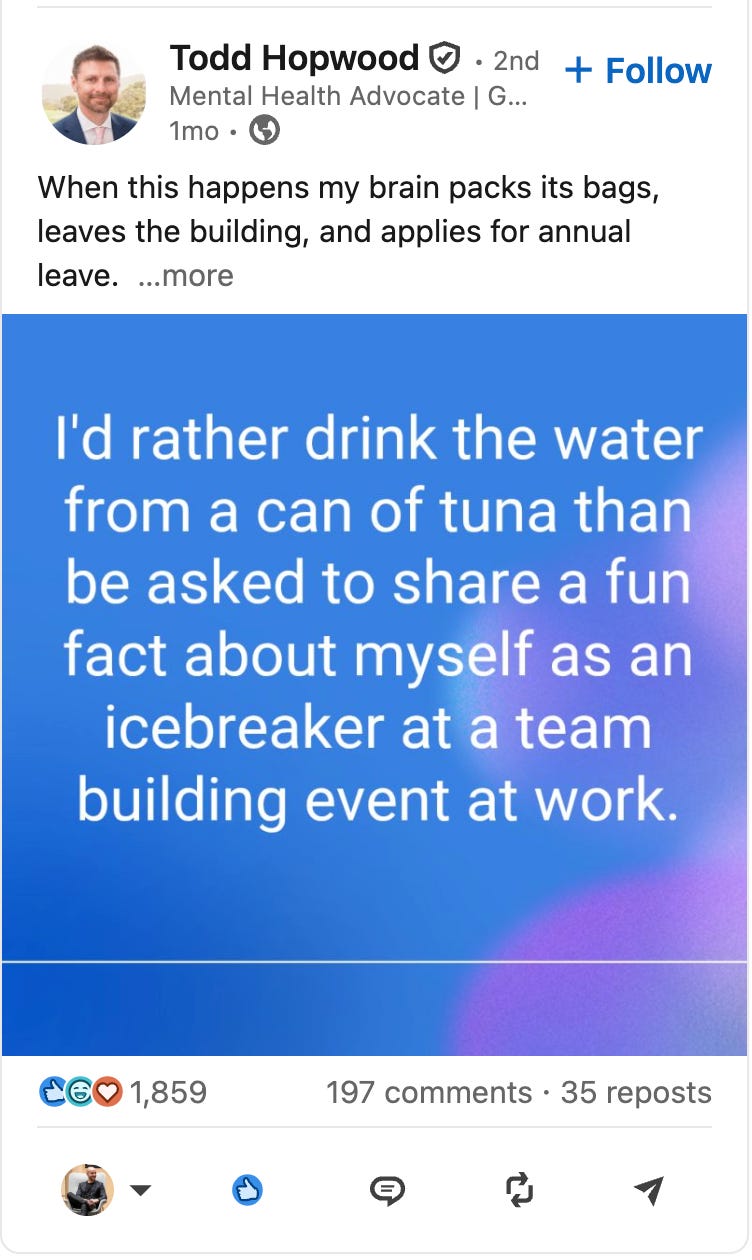
The active reincarnations of Grumpy Cat. Those with eternal resting b-faces. Not necessarily those that are fully devoid of life on the inside, but definitely not the person your average workshop facilitator hopes rocks up first to the session.
I, at best, feel discomfort when these types of activities occur around me. Occasionally, I experience active discontent. A real defensiveness that makes me want to rebel. I hear people talk about the positives of actively leaning into your inner child – to be playful and let your hair down. Have a bit of fun and all. And while I can rationalise about its benefits, doing it is a whole different ball game.
But while it may not feel fully natural to me to harness the benefits of play and playfulness, it doesn’t mean it couldn’t be beneficial to learn how to be. Plenty of things I don’t like are good for me, which got me thinking.
Can the joyless benefit from leaning more into fun and play? Is it something you can practice and obtain? Should I avoid going against my innate preferences, even if it may backfire? In other words, is there proverbial hope for my inner child or am I forever doomed to live my life as Oscar the Grouch?
P.s If you are Gen Z reading this, get ready for some wildly outdated memes and pop culture references from times when my life still had a faint resemblance of feeling ‘fun’. Let’s go.
What is this thing called joy?
I wanted to commence by exploring what we actually refer to when we talk about joy and fun. I want to better understand what it is I am supposed to experience when I sit through icebreakers. To do this, I did the most antithetical move I could think of and got stuck into scientific research on joy. How fun.
Anywho, this topic has received a bit of attention from people across a range of disciplines. A well-cited review on the topic of joy has been written by Matthew Kuan Johnson (2020), who dug deep into philosophical, theological, and psychological works on the topic.
Joy is often seen as a way to express positive affect. In other words, we think it is one part of our positive emotions and sensations. In his review, Johnson challenges this idea: while he does indicate that joy can be seen as a positive emotion, it is also much more than that, and simply seeing it as a positive emotion undersells the complexity of the experience. Joy can be analysed beyond the simple emotional expression. It can be seen as a mood, as well as a disposition, where certain people have a lower threshold to experience joy. In other words: joyful people truly exist, and as a consequence, so do Grinches like myself.
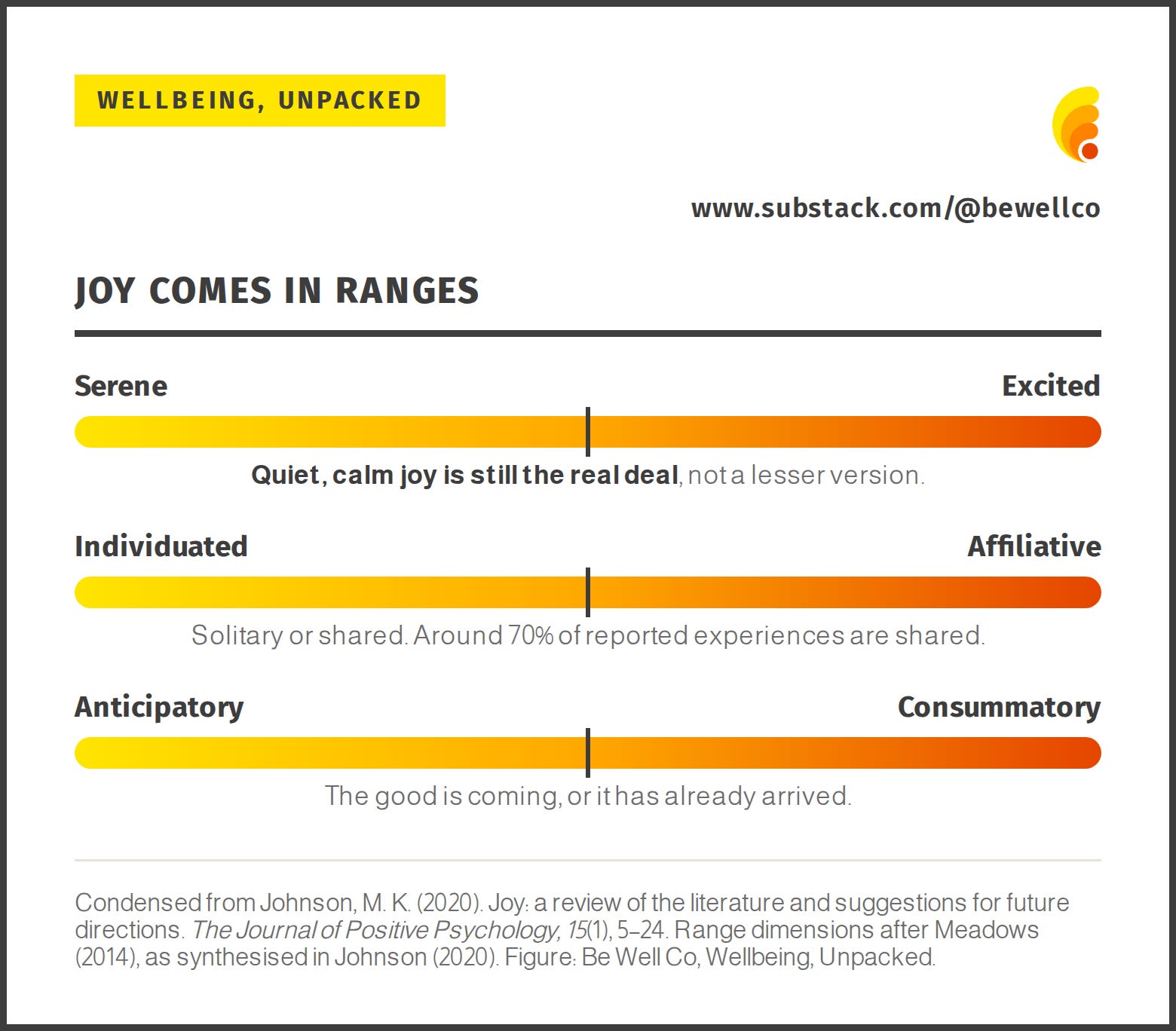
The paper outlines three interesting aspects of joy:
1. Like other emotions - joy can be experienced intensely and more sedate. In other words, the intensity of joy is one of its properties, not the defining feature. You can experience joy as childlike excitement, and you can experience it quieter. In other words, joy isn’t the same as pleasure or ecstasy. It can definitely take the form of excitement, but it can also be highly serene. In the absolute depth of feeling calm you can experience joy in its fullest.
2. Joy also isn’t a purely individual experience as it can be experienced with others. The majority of joy experiences are shared ones, an insight that blew my mind.
3. And interestingly joy can be based off anticipation (i.e. the good thing that causes joy is expected to come) or can be consummatory ( i.e. the good is here and you experience joy). This gives us a bunch of extra levers to pull when we think about harnessing joy, as we don’t have to have the physical trigger present; anticipation of it may be enough.
Johnson posits a very interesting definition of joy as being an emotion: a felt response to something good happening that genuinely matters to you and that you hoped for but didn’t presume. This definition highlights two key aspects that differentiate joy from pleasure and amusement. Let’s explore this using the example of watching a comedian.
1. Firstly, when you experience joy, there needs to be an element of surprise. If a comedian gives you a sense of joy, they need to have given you something you didn’t presume would happen. A punchline you can predict is less funny. If you keep rewatching the same romcom over and over again, the unexpected is taken out of the equation. You lean into comfort and pleasure, not joy.
2. To experience joy, the cause of joy needs to be personally relevant to you. A punchline that is funny but has no relevance to you can be amusing, but doesn’t lead to joy. It is pleasant, cortisol-reducing and worth doing, but it is low stakes. It becomes joy when it is high stakes, i.e. it matters to you. The comedian makes a funny joke about Dutch people, it has a higher chance to elicit joy in me compared to a joke about Polish people (the one exception being jokes about German people – they should elicit joy in everyone, but I digress)
How does having fun relate to joy?
Joy and fun are real partners in crime, but they differ fundamentally. Oh and Pham (2022) positions fun as needing to be a liberating engagement: a temporary release from your everyday restrictions, via an activity you’re absorbed in purely for the enjoyment of it. It has two pillars:
Pillar 1: Hedonic engagement: You are fully absorbed in the activity, for its own sake and the pleasure that comes from it. You don’t have external goals and it isn’t about things like ‘scores’. Adding a competitive angle makes the fun seep away.
Pillar 2: Sense of liberation: You feel temporarily released, from internalised restrictions such as work, duties, diets, self-monitoring etc. Fun includes freedom from something.
This means we can create a good old quadrant that pinpoints where fun sits compared to other pleasant experiences.
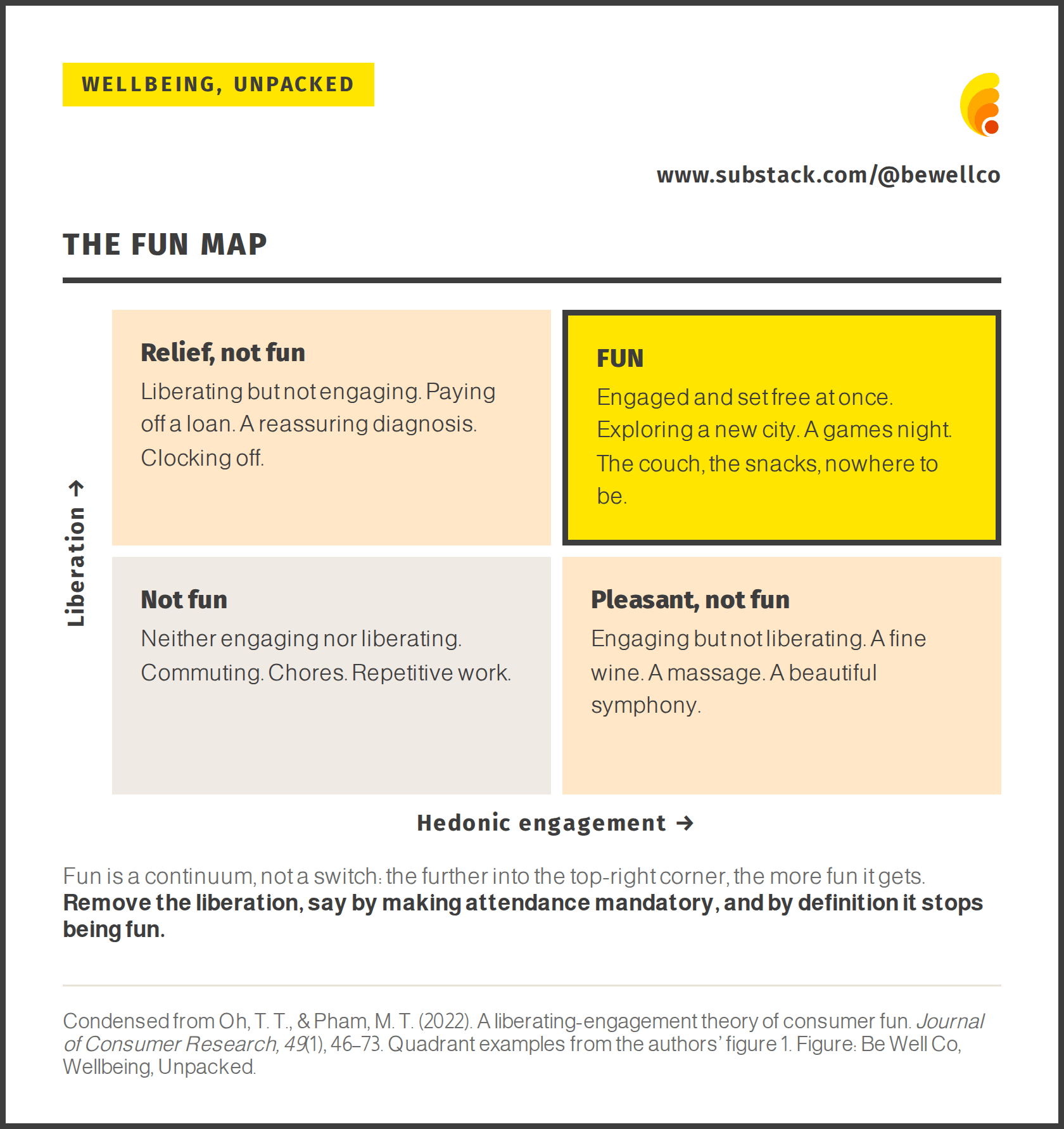
Having fun is a property of experiences you have or behaviours you do, while joy is the emotion you may experience as a result of it. Importantly, neither requires the other. For example, you can experience immense joy but not ‘have fun’, think of the birth of a child or someone giving you an unexpected compliment. Or you can have fun, but not experience joy, for example, watching a comedy movie.
Although they aren’t necessary ingredients, having fun - particularly shared fun - is a reliable way to get you to joy or, at a minimum, pleasure. The issue with both fun and joy is that they can’t easily be ordered on demand. Having fun is an experience, and joy is an emotion. So what’s left to actually work with? Enter my mortal enemy: (trivial) play.
Leaning into play and playfulness as a way to experience more fun
Play is a typical behaviour many lean into to experience fun and joy. It sits upstream of both. If you play, you are absorbed in an activity for no reason beyond the activity itself, and it should be fenced off from ordinary obligations. Play doesn’t guarantee fun, but it increases its likelihood.
It pays to want to play, and that’s where things get interesting. The willingness to play, i.e., playfulness, turns out to be trainable. René Proyer and his colleagues spent a decade looking into playfulness in adults, showing that it is a real, stable trait, but one we can work with. According to the two gentlemen, playful people have the tendency to work with everyday situations so that they are experienced as entertaining, interesting, or personally engaging. People high in playfulness see life through the prism of play. In 2017, Proyer wrote an article outlining the OLIW model, showing that there are different forms of playfulness:
Other-directed: playful with people: banter, good-natured teasing, and using play to ease tension and bring others together.
Lighthearted: the carefree, improvised approach to life: spontaneous, unworried, happy to see where the day goes.
Intellectual: playing with ideas: wordplay, puzzles, and turning problems over for the sheer pleasure of it.
Whimsical: amused by the odd and unusual: private rituals, a taste for the strange, finding the absurd in the everyday.
This gives people like me something to work with. I don’t have to feed into the top 2 parts, which are arguably those feeding the cultural stereotypes I resonate least with. No need to drink the tuna water. Rather, I can lean into the bottom 2 that I identify more with
So do extraverts have an advantage over me?
The earlier research seems to suggest that it doesn’t matter whether you are extraverted or introverted, loud or quiet. We can all learn to leverage play – and other activities - to create a sense of fun and experience joy (or pleasure). It isn’t simply something that the zesty extraverts benefit from.
That said, there is a catch, as they do have a slight upper hand, it seems. They are generally more prone to joy, but as per usual, it is complicated.
For example, Lucas and Baird (2004) ran a bunch of studies testing whether extraverts react more strongly to pleasant stimuli. They largely don’t, but they do seem to have a slight advantage related to so-called activated positive states (e.g. excitement). This is also supported by others, including work by Smillie and colleagues (2013;2015) showing that extraverts light up when there’s something to chase, and for them that response shows up as excitement and energy. They don’t respond any more strongly than the rest of us to things that are simply pleasant, like a nice video or a calm, enjoyable moment.
Which explains the love for a good old icebreaker. For extraverts, it is full of rewards: attention, laughs, people to win over. It is something they want, and getting it generates a buzz. Mine registers nothing worth chasing, so I get smacked with awkwardness. For me, it makes me feel like I need to perform (i.e., it is pressure), whether for them it is not, so long as they feel they want it.
And that is an important takeaway. Anything can be enjoyable so long as it fits your preferences. Some may have some innate advantage over others, but how this shows up is largely fuelled by satisfying a want. When people like me feel flat at the icebreaker, we’re not failing at joy. We were measured on the excitement register and don’t really want it that much.
But joy is about more than excitement. Having fun can be about by a range of activities, not just the stereotypical ones. So the message is clear. All hope is not lost. I can learn how to lean more into experiencing fun and play, and playfulness is a disposition I can nourish, but I am wise to make sure I don’t push boundaries too hard as this may backfire. Lyubomirsky and Layous’ (2013) person-to-intervention fit immediately comes to mind: their model of positive activities holds that whether an activity improves wellbeing depends on how well it matches the person doing it, not just on the exercise itself.
What seems vital is appropriate matching, as joy and a sense of fun are destroyed by the same enemies: obligation and force. And this point is important for any professional wanting to utilize play, fun & joy in their work, and for those who are seeking to lean into it personally a bit more. The literature gives some clear suggestions, which I will detail for our paid subscribers below.
